
Why seven days changes what seven months can't
Jun 09, 2026
Immersive sound healing training vs. weekly classes: the neuroscience behind why removing yourself from context is the mechanism, not the luxury.
There's a version of learning that happens in small increments over a long period of time. A class here, a workshop there, a certification module you complete on Sunday mornings between laundry and grocery lists. This kind of learning has real value. It keeps you growing. It adds layers.
But there's a different kind of learning — one that doesn't happen in increments at all. One that requires a full removal from your ordinary context, a sustained immersion in something new, and enough uninterrupted time for the thing you're learning to actually land in your body instead of just your notes.
These are not the same kind of learning. And for practitioners trying to make a meaningful shift in the quality and depth of their work, the difference matters more than most training programs will tell you.
What the Research Actually Shows
Neuroscience has been making the case for immersive learning for decades, and the findings are consistent: intensive learning experiences produce faster, deeper, and more durable change than the same content spread across weeks or months.
Here's why. The brain consolidates learning during rest — specifically during sleep, and during the unstructured downtime between focused learning sessions. When you attend a weekend workshop and then return to your regular life on Monday, the consolidation process gets interrupted. The neural pathways you started building get crowded out by the demands of your ordinary routine before they've had time to stabilize.
In an immersive container, something different happens. You learn. You rest in the same environment. You wake up and learn again. The consolidation process is protected because your nervous system isn't being pulled back into its familiar patterns every twelve hours. Research on intensive language immersion programs shows that learners in full-immersion contexts acquire fluency at dramatically accelerated rates compared to classroom learners — not because they're smarter or more motivated, but because the architecture of the learning environment supports deeper encoding.
The same principle applies to embodied practice. When a practitioner spends seven consecutive days learning, integrating, resting, and learning again — in a new environment, away from their clients and roles and responsibilities — the work has a chance to move from intellectual understanding into actual felt knowledge. Into the body. Into the nervous system. Into the place where it will actually be available to them when they're standing in a room with a client.
The Nervous System Needs Context to Change
There's another layer to this that doesn't get talked about enough in wellness education, and it's this: your nervous system is exquisitely sensitive to context.
The studio you teach in, the commute you take to get there, the mental load you carry from your practice management software and your client waitlist and your rent — all of it becomes part of the nervous system pattern associated with your work. You show up to your practice already patterned. Already in the role. Already running the familiar program.
This is not a criticism. It's physiology. Contextual cues trigger habitual neural responses. It's how the brain conserves energy. And it's precisely why trying to make a deep shift in your practice while remaining inside your ordinary context is so difficult. You're asking for new responses in the same environment that keeps cueing the old ones.
Removing yourself from that environment — genuinely, for a sustained period — is not a luxury. It's a mechanism. When you land somewhere entirely new, with no clients to see and no studio to run and no familiar demands pulling at your attention, your nervous system gets something it rarely gets: the chance to come out of its habitual patterns and actually receive something new.
This is why the most meaningful professional development experiences practitioners describe almost always happened at a residential training, a retreat, an immersive program somewhere away from home. Not because the content was necessarily better. Because the conditions for receiving it were.
What Seven Days in the Jungle Actually Does
I want to be specific about what happens over the course of a seven-day immersive practitioner training — not in abstract terms, but in the actual arc of the experience.
The first day or two, most practitioners are still decompressing. Still processing the transition, still carrying some of the mental weight of everything they left behind. This is normal and expected. The container holds it.
By day three, something shifts. The nervous system has begun to settle into the new environment. The familiar demands aren't there. Sleep, sound, movement, learning, conversation, integration — that's the whole rhythm. Nothing else. And in that simplicity, something opens.
The learning that happens in days four through seven is qualitatively different from what happens at the beginning — not because the content is different, but because the practitioner receiving it is different. More available. More present. Less defended by the roles and routines that usually mediate their experience.
This is what seven days can do that seven months of Sunday classes cannot. Not because the information is more densely packed. Because the conditions for genuine integration — nervous system settling, contextual pattern interruption, sustained immersion, protected rest — are present in a way they simply cannot be when you go home every night.
The Investment Reframe
I want to address something directly, because it's the question underneath most of the hesitation I hear about immersive training: is it worth it?
The honest answer is that it depends entirely on what you're comparing it to.
If you're comparing it to a weekend workshop — the immersive experience will cost more and produce more. Not marginally more. Categorically more, because the mechanism of change is different, not just the duration.
If you're comparing it to doing nothing — the question becomes what the plateau you're currently on is actually costing you. In energy, in engagement, in the slow erosion of the thing that made this work feel like a calling in the first place.
Seven days away from your ordinary life, in a container designed specifically to support deep practitioner development, in an environment that asks nothing of you except to learn and integrate — this is not an indulgence. It's one of the most efficient investments in your professional development you can make, precisely because it works with the architecture of how the nervous system actually learns.
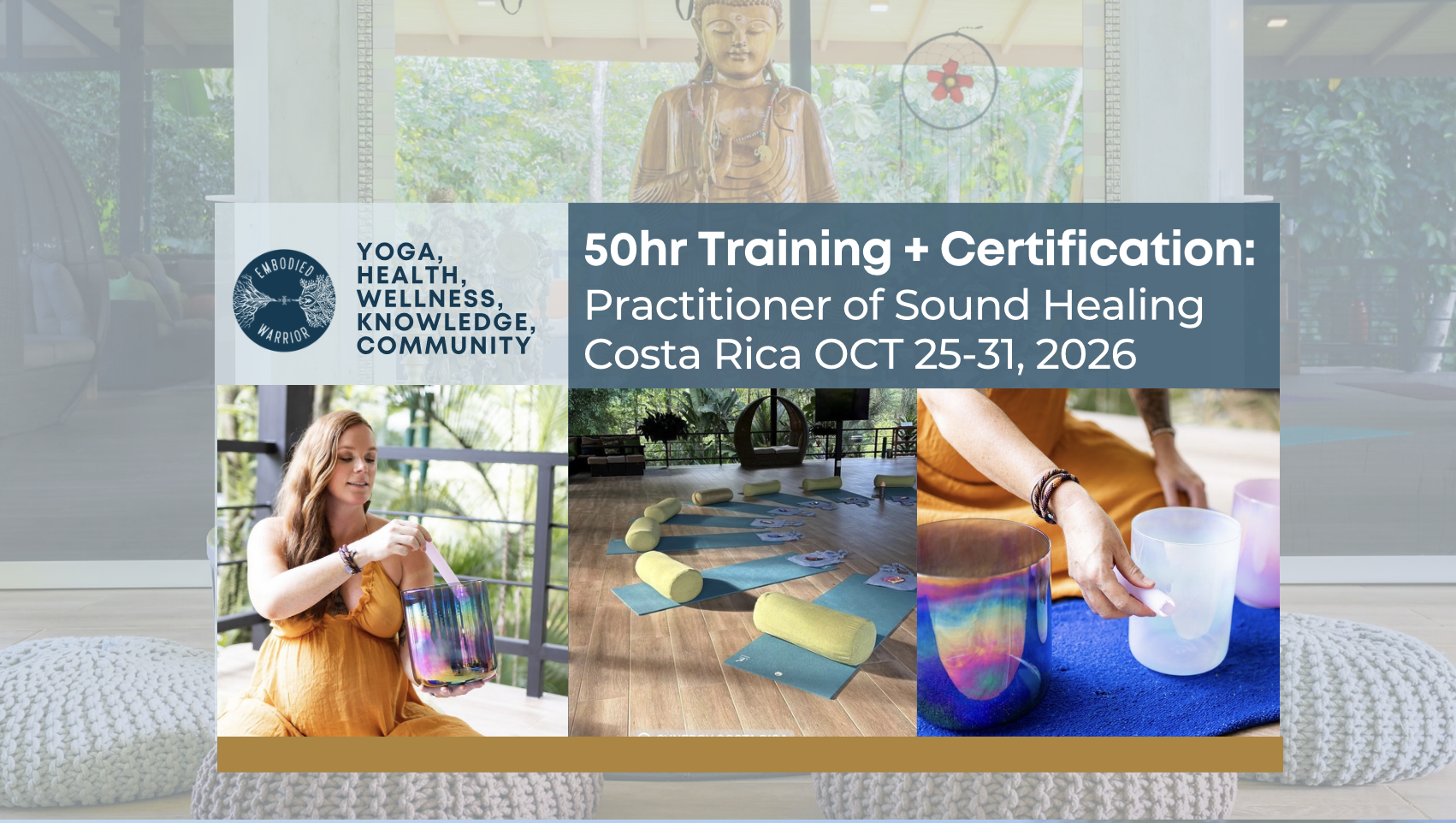
The October 50-Hour Sound Practitioner Training at Synergy Retreat Center in Uvita, Costa Rica is built on exactly this understanding. Seven days. A small cohort of established practitioners. A rainforest that has a way of making things very clear, very quickly.
Seven spots remaining.
[Details and registration →]
SUBSCRIBE FOR WEEKLY LIFE LESSONS
We hate SPAM. We will never sell your information, for any reason.
