
Why I Cap Enrollment at 12 — And What That Size Makes Possible
Jun 22, 2026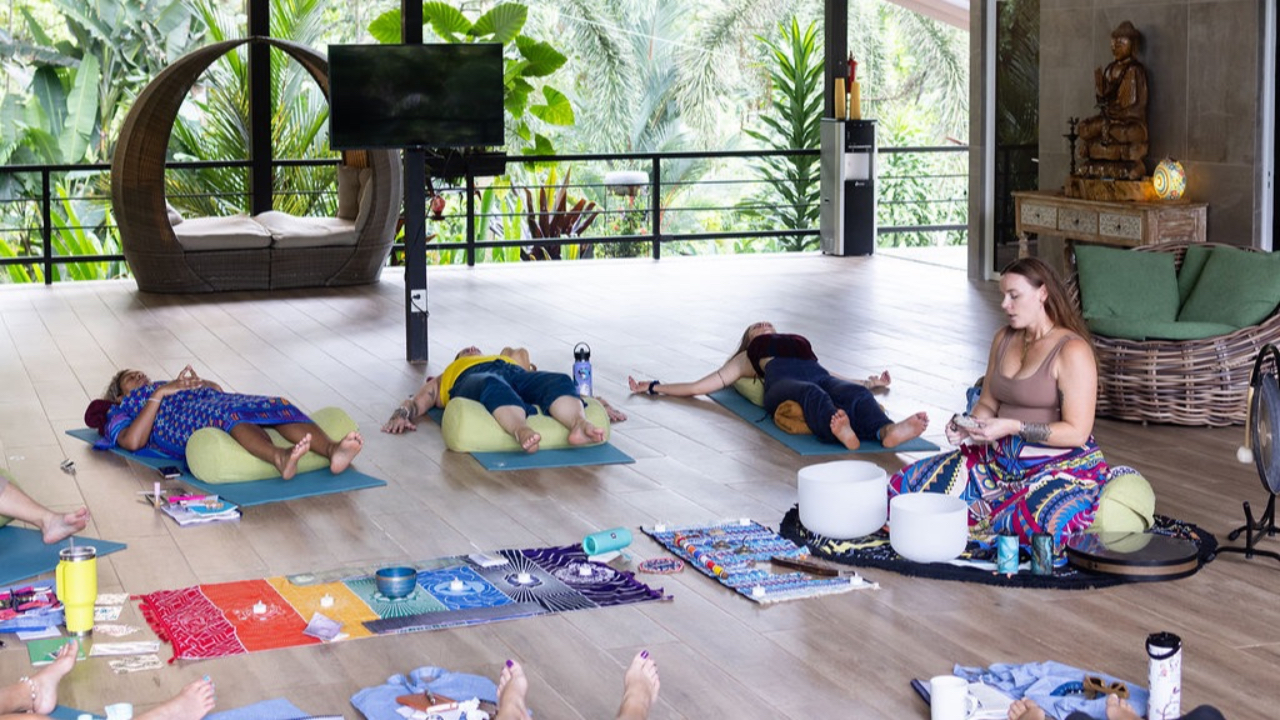
Most sound healing trainings pack the room. Here's why I deliberately don't — and what a small cohort of twelve makes possible that a room of thirty never could.
Someone found me through a Facebook group recently.
She had been quietly researching sound healing trainings for months — reading syllabi, comparing curriculums, scrolling through testimonials. She had a list of questions she'd been refining for weeks before she finally sent me an email.
The first question she asked wasn't about the curriculum. It wasn't about the instruments or the schedule or what was included in tuition.
It was: how many students do you accept?
My answer was 12. Me, plus two assistant teachers.
She wrote back within the hour.
I think about that exchange a lot. Because that question — before anything else — tells me everything about what she was actually looking for. She wasn't just looking for information about sound healing. She was looking for an experience that would actually change her. And somewhere in her research, she had already learned that the size of the room determines the depth of the work.
She was right.
What a Room of Thirty Cannot Give You
I've been in large trainings. I've sat in rooms where the teacher is brilliant and the content is solid and you leave with a full manual and a certificate and the distinct feeling that you were one of many.
That's not a criticism. It's just a reality.
When you have thirty students and one teacher, the math doesn't work in your favor. There isn't enough time for everyone to get hands-on practice with the instruments — really get it, not just a quick rotation. There isn't enough space for every student's questions to land, to breathe, to be followed up on. There isn't room for the kind of feedback that actually changes how you hold a bowl or how you read a room.
And there's something else that gets lost in a large cohort that rarely gets talked about.
The nervous system field.
When a small group of people spend seven days together moving through deep embodied work, something happens between them that can't be manufactured and can't be rushed. They begin to regulate together. Their systems start to recognize each other. The room develops a coherence that directly impacts the quality of learning — because you cannot teach nervous system regulation in an environment that doesn't model it.
Twelve people can build that field. Thirty people are still finding their footing by the time the week ends.
What Small Actually Makes Possible
When I say twelve students, here's what that number protects.
It means that during practice sessions, when we break into small groups, every student gets real time with the instruments. Not a brief rotation. Not a rushed attempt while someone waits behind them. Actual hands-on time — enough to make mistakes, receive feedback, try again, and start to feel the difference in their own hands.
It means I know every student's name by day one and their nervous system by day three. I know who tends to intellectualize when things get uncomfortable. I know who needs more encouragement to trust what they're feeling. I know whose voice drops when they get uncertain and whose playing gets louder when they're trying to overperform. That level of individualized attention is only possible when the room is small enough to actually see people.
It means the group discussions go somewhere real. In a room of thirty, group conversation tends to stay surface level — there are too many people, too many dynamics, too much social performance happening. In a room of twelve, people say the true thing faster. They ask the question they were afraid to ask. They admit what isn't working. That honesty accelerates learning in a way that no curriculum can replicate.
And it means the relationships that form during the training are deep enough to matter after it ends.
Why That Last Part Is a Professional Development Tool
The sound healing community is relationship-driven. The practitioners who build sustainable, meaningful careers in this work are almost always connected to a network of people who know their work, trust their presence, and send referrals their way.
When you train in a small cohort, you don't just leave with skills. You leave with people who experienced seven days of deep work alongside you. Who watched you grow. Who felt the quality of your presence. Who will recommend you, collaborate with you, reach out when they need support — because they actually know you.
That doesn't happen in a large room. It can't.
The Seven Remaining Spots Aren't a Marketing Hook
I want to be direct about something.
When I tell you there are seven spots left in the October training, I'm not saying it to create urgency. I'm saying it because twelve is the number the container is built for — and seven of those seats are already filled with people who made a decision and moved toward what they wanted.
The remaining spots aren't a scarcity tactic. They're the point.
This training was designed to be small because small is what makes it work. The depth of feedback, the quality of practice time, the nervous system field, the relationships — none of it is possible if I let the room grow past what it can hold.
So if you've been researching, comparing, refining your list of questions — I want you to ask them. Reach out. Let's have a conversation.
The woman who emailed me asking about cohort size? She's coming to Costa Rica in October.
Maybe you are too.
The 50-Hour Sound Practitioner Training + Retreat takes place October 25–31, 2026 at Synergy Retreat Center in Uvita, Costa Rica. Seven spots remain. Learn more or reach out at here.
SUBSCRIBE FOR WEEKLY LIFE LESSONS
We hate SPAM. We will never sell your information, for any reason.
