
The Inner Journey of Becoming a Sound Practitioner — What No One Tells You Before You Start
May 27, 2026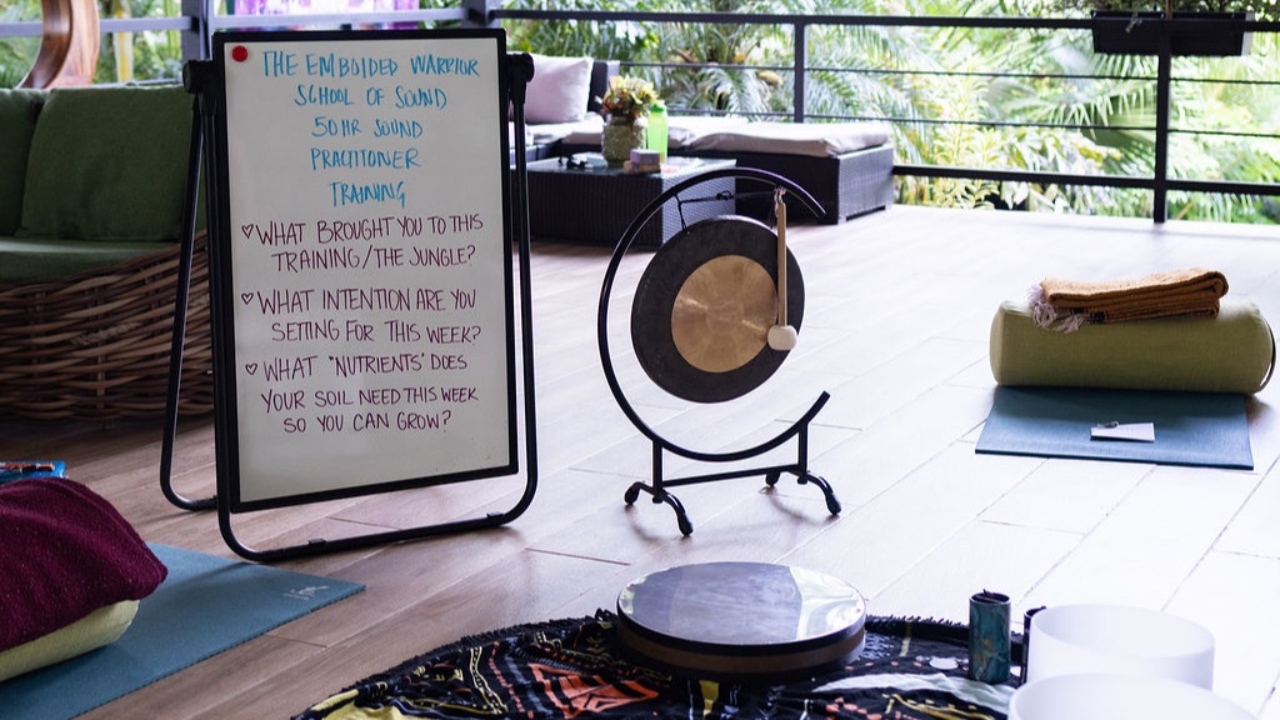
Becoming a sound healing practitioner isn't just about learning to play instruments. It's about developing a specific quality of presence, nervous system regulation, and inner capacity that no technique can replace. Here's what that journey actually looks like — from someone who's been guiding it for eight years.
Think about what you do when someone comes into your yoga class with their hips out of alignment.
You go over and adjust them. Or you call out a cue. You see what needs correcting and you address it. That's the job — and it's deeply ingrained after years of training.
Or think about what happens when a friend calls you mid-breakdown. Every instinct fires at once: offer something, suggest something, help them reframe, make it better. We do this as mothers, as partners, as friends, as practitioners. It is the most natural response in the world.
Sound healing asks you to override it entirely.
Not because care is wrong. But because in a sound healing session, the most powerful thing you can offer isn't a correction or a suggestion or a well-timed word. It's the quality of your presence — steady, unhurried, without agenda — held consistently enough that the person in front of you finally feels safe enough to let their own system do what it already knows how to do.
You're not the mechanism. You're the container.
And most of us were never taught how to be that.
What the instruments can't teach you
When a new practitioner walks into their first sound healing training, they're usually focused on the technical: which instruments to use, how to tune them, how to layer sounds, how to structure a session. These are learnable. They matter. A good training covers all of them.
But here's what I've observed over eight years of teaching this work: the practitioners who create real, lasting change in their clients aren't necessarily the most technically skilled. They're the ones who have developed a specific quality of presence — the capacity to be in a room with whatever arises and stay grounded, stay steady, stay genuinely there.
That doesn't come from knowing the right frequencies or owning the right instruments. It comes from inner work. And inner work requires a different kind of training entirely.
The first shift: learning to trust silence
Almost every practitioner goes through the same early phase. When the room gets really quiet — the kind of silence that has actual weight — they fill it.
They say something. Play something. Reach for a cue or an explanation. Anything to break the tension of not knowing what comes next.
This is the fixing instinct in action. We are wired to respond to discomfort by reducing it — in ourselves and in others. The impulse to fill silence, to narrate what's happening, to offer reassurance when someone is mid-experience — it comes from care. It's the same instinct that makes you reach over and adjust someone's alignment.
But in a sound healing session, that impulse interrupts the work. The silence after a sustained tone, the pause between bowls, the held breath before the next note — that's where the body integrates. Where the nervous system processes. Where what has been waiting finally has somewhere to go.
When you fill that silence, you pull people back to the surface. Back to the analytical mind. Back to the place where things have to be managed.
Learning to trust the silence — to stay present while it does its work without doing anything yourself — is one of the most significant shifts in a practitioner's development. And it only happens through practice, reflection, and an environment that holds that standard.
The second shift: understanding what your nervous system is doing
Here's something that doesn't get said enough in practitioner training: your nervous system is active in every session. It's not neutral. It's not just a vessel for the sound.
When you are genuinely regulated — calm, present, grounded — that state communicates safety to everyone in the room. Their nervous systems read yours. They co-regulate with you. Your steadiness becomes the container they can release inside.
This is co-regulation — one of the most well-documented mechanisms in trauma-informed somatic work. Human nervous systems evolved to read safety cues from each other. A regulated practitioner broadcasts safety with every breath, every choice about when to play and when to be still, every moment of trusting rather than managing.
The inverse is equally true. When a practitioner is anxious — about whether the session is working, whether they're doing it right, whether they look credible enough — the room feels that. Not consciously, necessarily. But the nervous systems present respond to it.
This is why your own regulation isn't a personal practice that's separate from your professional development. It is your professional development. The quality of your nervous system is the quality of your container.
And the container is everything.
The third shift: holding vs. performing
There's a version of sound healing that looks like presence but isn't.
It's the version where the practitioner knows all the right things to say, has cultivated the right aesthetic, moves through a session with practiced ease — and yet something is slightly flat. The room is pleasant but not transformative. People leave rested but not different.
Performing presence is not the same as embodying it. And clients feel the difference even when they can't name it.
Real presence is quieter. Less polished. More willing to not know. It trusts the process enough to follow rather than lead. It can be with what's arising without immediately doing something about it. It's in service to the client's experience — not to its own image of being helpful.
Developing that quality requires turning toward your own relationship with discomfort, with uncertainty, with not being in control. It requires enough self-awareness to distinguish your anxiety from your client's experience — and enough inner resource to choose their experience over your own comfort.
That's the inner journey. And it's not linear, and it's not finished.
I'm still on it — as a practitioner, and right now as a new mother with a 9.5 month old who just started walking, running on what I can only describe as blind optimism and nervous system training. The fixing instinct is at an all-time high.
But here's what eight years has taught me: the moments I'm most effective in a session are never the moments I'm doing the most. They're the moments I'm the most still. The most trusting. The most willing to let whatever is happening in the room belong entirely to the person experiencing it.
That capacity is built. It doesn't just appear. And it's one of the things I'm most committed to developing in every practitioner who comes through my training.
What this looks like in a real training
When I designed my 50-hour Sound Practitioner Training, I built the inner work into the architecture of the week — not as a module, but as the thread running through everything.
We cover the nervous system science, the physics of how sound moves through the body, the ethics and scope of practice, the business of building a sustainable livelihood. All of it is there and all of it matters.
But the frame around all of it is: who are you when you step into the room? What does your presence communicate before you play a single note? What happens in your body when someone starts to cry, or shake, or go somewhere you didn't anticipate? And how do you develop the capacity to stay with that — steadily, skillfully, without interrupting it?
Those questions don't have quick answers. But a week in an intentionally small container — in Costa Rica, away from the daily noise — creates the conditions to begin answering them. To practice them in real time. To feel what it's like to be held in genuine safety and to develop your own capacity to offer that.
I don't train carbon copies. What comes out of October isn't fifteen practitioners who all sound like me. It's fifteen practitioners who finally sound like themselves — with the science, the skill, and the inner development to back it up.
What practitioners say about the journey
Mallory came to the training as a Licensed Professional Counselor with nearly two decades of clinical experience. She understood nervous system work. She knew trauma-informed care. What she needed was a training she could trust — one that held the same standards she held in her own clinical practice.
"I cannot speak highly enough of this training. As a Licensed Professional Counselor for almost two decades, I am continuously looking for ways to expand my knowledge and advance my skills to heal others and improve clinical outcomes. It is imperative to work with both the mind and body. Sound healing, I believe, is on the frontier of healing — it goes beyond the workings of the mind and body and works with our frequencies to assist in nervous system regulation.
My training with Megan was extensive, informative, and highly crafted. When I am in search of training beyond my scope of practice, it is vital for me to have someone who is highly knowledgeable and works within an ethical and loving framework. With Megan you can trust that what you are receiving is of high quality and know that the safety of all is being ensured.
Megan, while trauma-aware, knows the scope of her own training and is highly professional in how to direct and assist. The sense of connection and love was unmatched to anything I have previously attended in such an intimate setting. All are honored. All are loved."
— Mallory, Licensed Professional Counselor
What Mallory is describing — the trust, the ethics, the trauma-awareness that knows its own scope — those aren't accidents of a good week in Costa Rica. They're the result of eighteen years of building a practice and a curriculum on the actual science of this work. On the belief that the people who show up deserve to be held by someone who really knows what they're doing.
And they're available to every practitioner willing to do the training that develops them.
Who this journey is for
The yoga teacher who wants to work with the nervous system at a deeper level. The massage therapist who knows the body is holding things that hands alone can't reach. The breathwork facilitator who's seen what happens when someone drops fully into their body — and wants to create more of those moments. The therapist or counselor looking for a tool that works below the level of language.
It's for the practitioner who takes their work seriously enough to want real training — not just a certificate, but the science, the ethics, the inner development, and the community that holds you accountable to all of it.
And it's for the woman who's felt the pull toward this work long enough to know it isn't going away.
October 25–31, 2026 · Uvita, Costa Rica · 7 spots remaining
If this is the training you've been waiting for — the one that treats you as a whole practitioner, not just a set of techniques to fill — I'd love to have you in the room.
All the details are at theembodiedwarrior.com. Or reach out directly — reply to this blog, or send a message through the site. I'm happy to answer questions and help you figure out if this is the right fit.
The pull you've been feeling is real. And you're more ready than you think.
— Megan
SUBSCRIBE FOR WEEKLY LIFE LESSONS
We hate SPAM. We will never sell your information, for any reason.
