
The Difference Between a Sound Practitioner and a Sound Leader — And Why the Wellness World Needs More of the Latter
Jul 14, 2026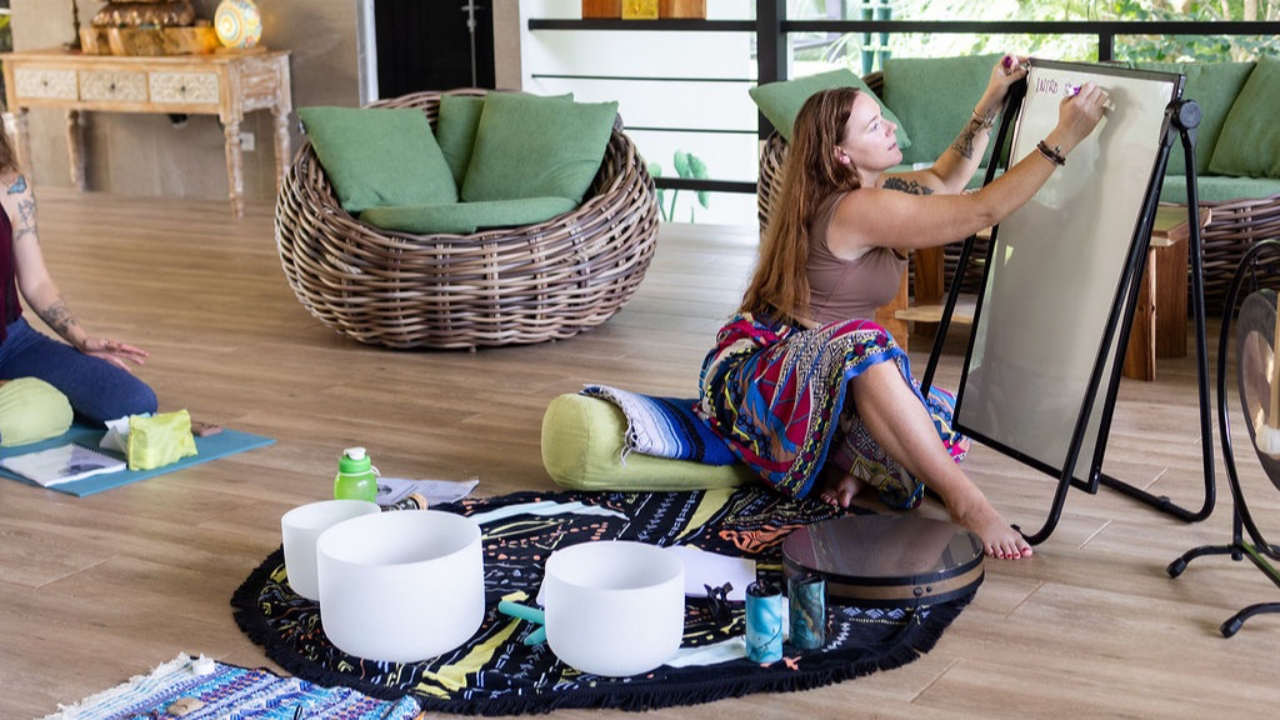
Most sound training programs produce practitioners. TEW School of Sound trains leaders. Here's what that distinction looks like — and why it changes everything.
The sound healing space is growing.
More practitioners. More training programs. More bowls being played in more studios in more cities than at any point in the history of this work finding its way into Western wellness culture. If you search for a sound bath in almost any mid-sized city right now, you will find one. Probably several.
This is, in many ways, a beautiful thing. More people are accessing this work. More nervous systems are getting the reset they need. More practitioners are finding their way to a modality that finally feels like the missing piece.
And it has created a problem that nobody in the industry is talking about directly.
We have an abundance of practitioners. We have a shortage of leaders.
I want to be precise about what I mean by that — because the distinction is not about ego or status or who has the most impressive credential. It is about what the wellness world actually needs from the people who carry this work forward. And right now, what it needs most is not more people who can facilitate a sound bath. It is people who understand this work at a level that allows them to shape how their community understands it.
What a Practitioner Does
A practitioner executes.
They set up their instruments, hold the container, guide their participants through an experience, and close the session. They know their modality. They have put in the hours. They show up reliably and their clients leave feeling better than when they came in.
This is real and valuable and not nothing. The world needs skilled practitioners. And execution, done well, is an art.
But execution has a ceiling. When something unexpected happens in the room — a participant in acute distress, a nervous system response that doesn't follow the expected arc, a session that needs to be redirected in real time — the practitioner who only knows how to follow a script has nowhere to go. When a client asks a question that goes beyond the surface of the modality, the practitioner who learned technique without understanding mechanism cannot give a satisfying answer. When the work needs to grow, to evolve, to be adapted for a new population or a new context, the practitioner who was only trained in one way of doing things has limited options.
Execution without deep understanding produces practitioners who are competent until the moment something requires more than competence.
What a Leader Does
A leader understands the mechanism.
Not just what to do in a session — why it works. Not just which frequencies to play — what is happening in the nervous system when those frequencies land. Not just how to hold space — what co-regulation actually is at a physiological level and how to cultivate the internal state that makes it possible.
A leader can adapt in the room because she understands the principles underneath the technique well enough to make real-time decisions that serve the person in front of her. She can answer the hard questions — from clients, from skeptical colleagues, from the physician who wants to know why her patient keeps coming back from sound sessions with measurably lower anxiety. She can teach, because she holds the material at a level that goes beyond what she was shown.
And beyond the room, a leader shapes something larger.
She becomes the person in her community that people send their friends to when nothing else is working. Not because she markets herself well — because she holds the work with enough depth and integrity that her reputation precedes her. She builds offerings that extend beyond individual sessions. She creates spaces — literal and metaphorical — where her community can access this work in multiple ways. She is not one of many practitioners in a crowded market. She is the trusted voice.
That is a different thing to build. And it requires a different kind of training to get there.
What the Training Has to Do Differently
Most sound healing certification programs teach technique. Some teach theory. Very few teach both at a level that produces genuine understanding rather than rote execution — and fewer still address what happens after the certificate.
What do you do with this work once you have it? How do you build a practice that is sustainable and respected and compensated appropriately? How do you position yourself in a market that is increasingly crowded with people who took a weekend course and bought a set of bowls? How do you become the practitioner that people seek out specifically — not the one they find because they searched for "sound bath near me"?
These are not business questions separate from the training. They are part of what a leader needs to know. And a program that trains leaders has to hold all of it — the science, the embodiment, the ethics, the presence work, and the practical architecture of building something real.
This is what TEW School of Sound is built to do.
TEW is not a weekend training with a certificate at the end. It is a school — with a curriculum developed over nearly a decade of international teaching, a philosophy grounded in applied health physiology and somatic practice, a track record of graduates who have gone back to their communities and changed things, and a standard for what a sound practitioner should be able to understand, embody, and offer that most programs in this space do not approach.
When someone completes a TEW certification, they are not just trained. They are prepared. There is a difference.
What Leadership Actually Looks Like: Nina
Nina flew halfway across the world to attend the TEW 50-Hour Sound Practitioner Training in Costa Rica.
From Sweden. After one email exchange. Without ever meeting me in person.
She did not need a sales funnel or a discovery call or a carefully sequenced nurture campaign to make that decision. She read about the training, she felt something, she sent an email, and she was in. That kind of clarity — the kind that moves someone across an ocean on a single exchange — does not come from good marketing. It comes from a person who already knows, at some level, that this is the next right thing.
What happened after she landed back in Sweden is what I want you to understand about what this training actually produces.
Less than a year later, Nina opened her own sound healing studio. She began leading community sound baths and building a local following of people who had never encountered this work before and didn't know they needed it until they found her. And then something happened that I think is one of the most telling signs of what a leader does with this work: people were so drawn to it, so moved by what they were experiencing in her sessions, that they wanted to understand it. They wanted to know more. So Nina created a twelve-hour introductory course on sound healing — and they came.
She didn't wait to feel ready. She didn't wait for permission or a larger platform or the right moment. She took what she learned, brought it home to her community, and started changing things there.
That is leadership. Not the title. Not the credential hanging on the wall. The willingness to walk back into your community with what you now know and do something real with it.
Sweden. A studio. A course. A community that found sound healing because Nina got on a plane.
That is what TEW trains for.
Why the Wellness World Needs This Now
Sound healing is at an inflection point.
It is moving from the margins of wellness culture toward something more mainstream — which means the quality of what gets called sound healing, and the standard of who gets called a sound healer, is going to be set by the people who are doing this work right now. The practitioners who are in the room in the next few years will define what this modality means to the communities they serve.
That is not a small thing to be a part of.
The wellness world does not need more people who can play bowls in a dimly lit room. It needs more people who understand why the work matters, can explain it to a skeptic, can hold a participant in genuine distress with clinical grounding and human presence, can build something sustainable enough to still be doing this in twenty years.
It needs leaders. People who took this work seriously enough to learn it at a level that lets them carry it forward with integrity.
That is who October is for.
October Is Where the Next Cohort Begins
The TEW 50-Hour Sound Practitioner Training + Retreat runs October 25–31 at Synergy Retreat Center in Uvita, Costa Rica. It is the last time this container exists at this location — the final training in a chapter that has produced practitioners who went home and opened healing spaces, built new offerings, changed the conversation in their communities.
Six spots remain for the cohort that closes it.
If you have been waiting to take this work seriously — this is the moment. Not to become one of many. To become one of the few who actually understands what they are doing and why.
SUBSCRIBE FOR WEEKLY LIFE LESSONS
We hate SPAM. We will never sell your information, for any reason.
