
You Don't Need More Bowls. You Need Better Training.
May 13, 2026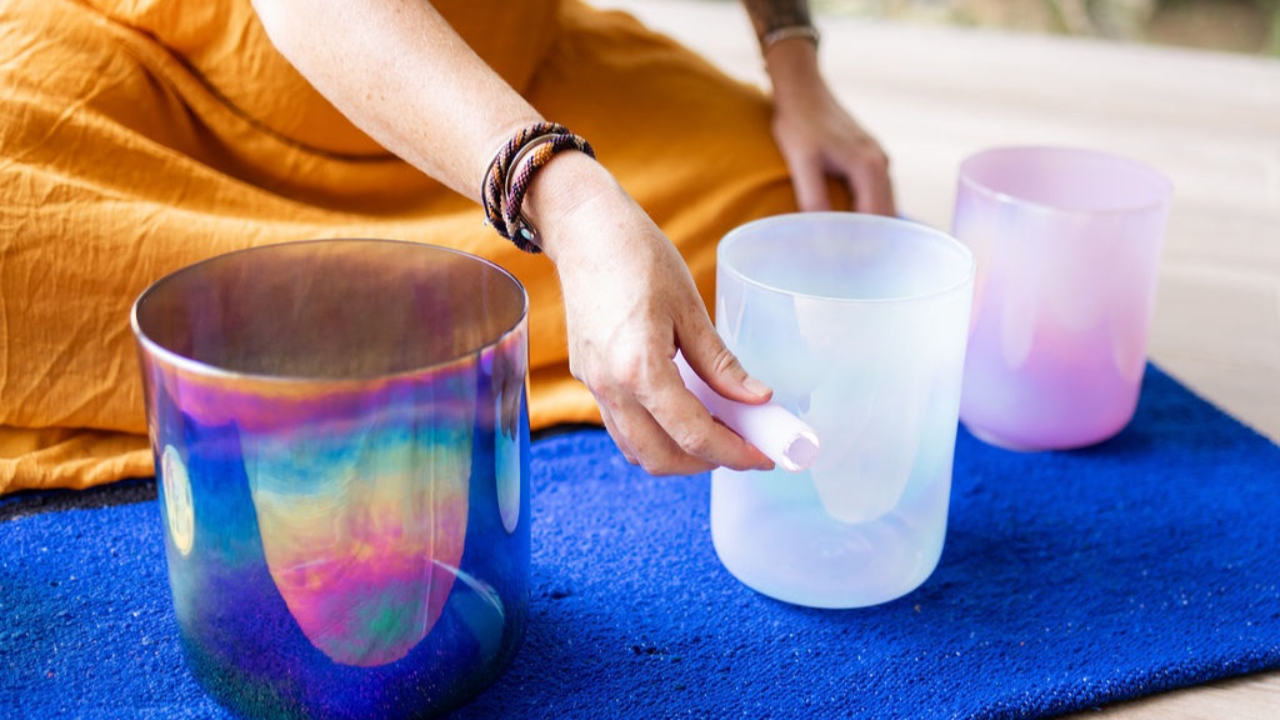
The sound healing industry has a toolkit problem. Here's what actually makes a skilled practitioner — the science behind it, the inner work required, and what to look for in a training that takes both seriously.
There's a version of the sound healing world I've watched grow over the past decade that concerns me.
It's the version that equates quality with equipment. That measures a practitioner's credibility by the size of their instrument collection. That sells transformation through acquisition — one more bowl, one more certification, one more upgrade to the setup — and quietly sidesteps the most important variable in the room.
You.
I've been in the energy healing field for fifteen years, and practicing sound healing for the last seven. I hold a Master's in Applied Health Physiology. I've trained practitioners across multiple countries and built a curriculum I'm genuinely proud of — one grounded in science, somatic practice, and the kind of inner development work that most trainings don't touch.
And I want to say clearly, to anyone who's in this world or considering entering it: more instruments will not make you a better practitioner. A regulated nervous system, a trained presence, and a deep understanding of what's actually happening in the body when sound is used skillfully — that's what makes a better practitioner.
Let me explain why.
First: what sound actually does in the body
Before we can talk about what makes a skilled practitioner, we need to talk about the mechanism — because most people in the sound healing world are working with an incomplete picture of what they're actually doing.
Sound, at its most fundamental, is vibration. The human body is approximately 60% water. Vibration moves through water the way it moves through any conductor — completely, throughout the entire system. Which means when you play a singing bowl, the sound doesn't stop at your client's eardrums. It travels through their tissue, their fluid, their fascia, their cells. Their entire body receives it.
Fascia — the connective tissue that wraps around every organ, muscle, and bone — is particularly responsive to vibration. It transmits sound throughout the body like a resonance chamber. This is why people feel bowls in their chest, behind their eyes, in places they can't quite name. That's not imagination. That's physiology.
And in the brain, something equally important is happening. Sound — when used with intention and skill — guides the brain through measurable frequency states. From beta (alert, analytical, running the to-do list) through alpha (relaxed awareness) into theta — the deep, liminal state where stored emotion surfaces, where the body lets go of what it's been holding, where the 'something shifted' experience becomes possible.
This is why sound healing can reach places that talk therapy and even hands-on bodywork sometimes can't. It doesn't ask permission from the thinking mind. It moves through the body directly — below the analytical, below the defended — and meets what's actually there.
Understanding this changes how you work. It changes what you listen for, what you adjust, what you trust. And it changes what you understand your role to actually be.
The instrument is not the point. You are.
Here's the thing about all of that beautiful, complex physiology: none of it activates automatically just because there are instruments playing.
The brainwave shift doesn't happen on its own. The nervous system doesn't soften on command. The fascia doesn't release because a bowl is singing.
All of it depends on the quality of the container — the safety, the pacing, the presence of the person holding the space. And the container is built entirely by the practitioner.
When you are regulated — when your nervous system is calm, present, and grounded — that state is palpable. The people in your space feel it, even if they can't name it. Their nervous systems respond to yours. This is co-regulation: a well-documented mechanism in trauma-aware, somatic work. Human nervous systems evolved to read safety cues from each other. A regulated practitioner broadcasts safety with every breath, every choice about when to play and when to be still, every moment of not filling the silence.
The inverse is also true. When a practitioner is performing presence instead of embodying it — when they're executing a plan instead of listening to the room, when they're managing their own discomfort instead of holding their client's experience — the room feels that too. People leave vaguely disappointed, unable to name why.
I've seen a $4,000 set of crystal bowls do nothing.
And I've watched someone hold a room completely still with their voice and a single frame drum.
The practitioner who shows up fully regulated with a $40 frame drum will hold a better space than the one who hasn't done their inner work but owns every bowl on the market. Every time.
Your tools amplify who you are. They don't replace it.
What the industry gets wrong — and why it matters
The sound healing training market has grown rapidly, and with that growth has come a proliferation of programs that teach technique without depth. Bowls without biology. Certification without the inner work that makes certification meaningful.
I understand why. The inner work is harder to sell. You can photograph a bowl collection. You can't photograph a regulated nervous system.
But the consequence is a field full of well-intentioned practitioners who don't fully understand what they're doing — who are playing instruments without understanding the physiological mechanism, who are holding space without having developed the capacity to stay grounded when the room gets big, who are improvising in moments that call for trained skill.
This matters because people come to sound healing in vulnerable states. They come carrying things they haven't been able to put down anywhere else. They come because something in them knows that the body needs to be met — and they're trusting the practitioner in front of them to know how to do that.
That trust deserves to be met with real preparation. Not just a certification and a bowl collection.
What real preparation actually looks like
A well-trained sound practitioner understands the physiology — how sound moves through the body, what happens in the nervous system and brain during a session, why different people respond differently to the same frequency.
They understand the mechanism of co-regulation — and they take their own regulation seriously as a professional responsibility, not just a personal practice.
They have developed the capacity to hold silence without filling it. To stay steady when someone moves through an emotional release. To read the room and adjust in real time rather than executing a predetermined plan.
They know their scope of practice — and they hold it with confidence, neither shrinking from the depth of the work nor overreaching into territory that requires different training.
And they have done enough of their own inner work to know the difference between presence and performance. Between holding and managing. Between being in the room and being watched being in the room.
These are trainable skills. They take time, reflection, and a training environment that takes them seriously.
What this looks like in practice
Sam came to October's training knowing she wanted to work with sound — she’d dabbled, felt the pull, and knew she wanted to host her own sound baths. What she didn’t have yet was the foundation. The science, the hands-on practice, the training she could stand behind with confidence when she stepped into a room and held space for others.
"If you're seeking a training that offers genuine connection, evidence-based teaching, hands-on practice, and a supportive learning environment — I highly recommend the 50-hour Sound Healing Practitioner Training and Retreat with Megan. I truly walked away more confident, more aligned, and inspired to bring this work into the world."
— Sam
More confident. More aligned. Inspired to bring this work into the world — with the knowledge to back it up.
That’s not what happens when someone just teaches you how to play instruments. That’s what happens when a training gives you the science, the practice, and the inner development to walk into any room and know — deeply, not just technically — what you’re doing and why.
Who October is for
My 50-hour Sound Practitioner Training and Retreat in Costa Rica is built for wellness professionals who are ready for that depth.
You might be a yoga teacher, a massage therapist, a breathwork facilitator, or a somatic practitioner who's felt the pull toward sound for years. You might already be working with sound informally and know you need a stronger foundation. You might be earlier in your journey and want to build it right from the start.
What you have in common: you take the work seriously. You want to understand the mechanism, not just the experience. You want to become the kind of practitioner people leave feeling genuinely different — not just relaxed.
Over eight days in Costa Rica, we go deep on the nervous system science, the physics of sound in the body, the ethics and scope of practice, the business of building a sustainable livelihood, and the inner development work — regulation, presence, signature frequency — that makes everything else land.
We build practitioners who understand what they're doing and why. Who can hold a room with confidence and steadiness. Who know the difference between playing sound and holding space.
Eight spots remain for October. If this is the training you've been looking for — I'd love to have you in the room.
All the details are at theembodiedwarrior.com. Or reach out directly — reply to this BLOG POST, or send a message through the site. I'm happy to answer questions and help you figure out if this is the right fit.
— Megan
SUBSCRIBE FOR WEEKLY LIFE LESSONS
We hate SPAM. We will never sell your information, for any reason.
